Research
Pollution, modeling, and sustainability science: understanding how human activities affect well-being, and informing decisions toward sustainability.
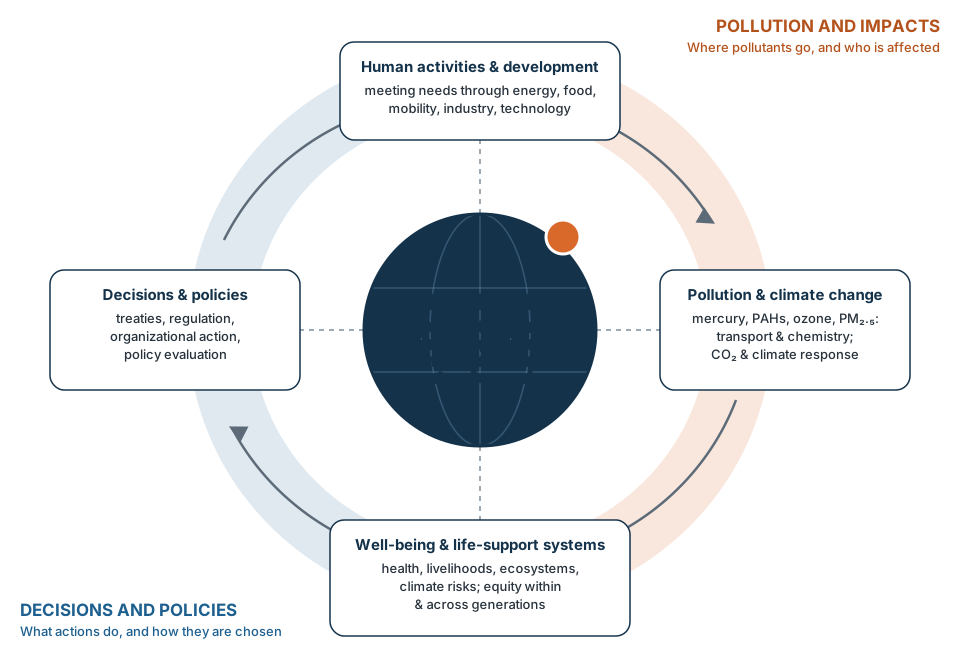
Our group works in sustainability science, a field that studies the interactions between human and natural systems in order to support sustainable development. Our research examines how human activities, the pollution they generate, and the decisions societies make interact to shape human well-being, livelihoods, and Earth's life-support systems, now and for future generations. Human activities and development meet needs for energy, food, and mobility through industry and technology, but they also release air pollutants and greenhouse gases. These affect climate, health, and ecosystems, often unequally. Those impacts in turn inform decisions and policies, which reshape human activities. Our ultimate goal is to inform policies and decisions towards greater sustainability.
We organize our work around three connected areas: Pollution and Impacts, Systems Modeling and Decisions and Policies. Many of our projects span two or all three areas.
Pollution and Impacts
We study how air pollutants such as mercury, polycyclic aromatic hydrocarbons (PAHs), ozone and fine particulate matter (PM2.5) are emitted, transported and transformed, and how pollution and climate change affect human health, ecosystems and well-being. Mercury and other persistent, toxic pollutants travel globally through the atmosphere and accumulate in food webs, affecting people far from emission sources. We use atmospheric chemistry models and observations to identify where pollution comes from, including past, present, natural, and anthropogenic sources, and how it responds to changing emissions and a changing climate. We then link model output with exposure and health analysis to trace impacts from sources to the people and places affected, with attention to equity within and across generations.
Selected publications
- A. Feinberg et al. (2024). Unexpected Anthropogenic Emission Decreases Explain Recent Atmospheric Mercury Concentration Declines. PNAS 121(42), e2401950121.
- L. Cicone, A. Y. H. Wong and N. E. Selin (2026). Quantifying the Wildfire Contribution to PAH Concentrations and Health Effects. Environmental Research Letters 21(10), 104011.
- E. LeRoy et al. (2025). Impact of Climate Variability and Change on the Surface Ozone Response to NOx Emissions Reductions. Environmental Science & Technology 59(21), 10422–10433.
- A. Y. H. Wong et al. (2024). Climate and Air Quality Impact of Using Ammonia as an Alternative Shipping Fuel. Environmental Research Letters 19, 084002.
- J. M. Kelly et al. (2021). Global Cancer Risk from Unregulated Polycyclic Aromatic Hydrocarbons. GeoHealth 5, e2021GH000401.
Systems Modeling
We build and use a range of modeling tools to address questions driven by decision-maker needs. These modeling tools range from detailed atmospheric chemistry models of air pollutants, to fast, AI-based emulators that reproduce the behavior of complex climate and chemistry models in seconds, to frameworks that connect interacting natural and societal systems. Fast tools let us explore many possible futures and quantify uncertainty. Systems frameworks help us see how human, technical and environmental components interact. We integrate data analysis and evaluation, as well as uncertainty analysis, in all of our modeling approaches. Our suite of tools can help give decision-makers actionable information about the trade-offs and synergies among paths toward sustainable development.
Selected publications
- C. Tebaldi, N. E. Selin, R. Ferrari and G. Flierl (2025). Emulators of Climate Model Output. Annual Review of Environment and Resources 50, 709–737.
- C. B. Womack et al. (2026). Optimal Scenario Design for Climate Emulation. PNAS 123(46), e2620731123.
- A. Y. H. Wong, S. D. Eastham, E. Monier and N. E. Selin (2026). A Geographically Weighted Gaussian Process Regression (GW-GPR) Emulator of Anthropogenic PM2.5 from the GEOS-Chem High Performance (GCHP) 13.0.0 Global Chemical Transport Model. Geoscientific Model Development 19, 3335–3360.
- W. Atkinson et al. (2022). A Tool for Air Pollution Scenarios (TAPS v1.0) to Enable Global, Long-Term, and Flexible Study of Climate and Air Quality Policies. Geoscientific Model Development 15, 7767–7789.
- N. E. Selin, A. Giang and W. C. Clark (2023). Progress in Modeling Dynamic Systems for Sustainable Development. PNAS 120(40), e2216656120.
- H. Selin and N. E. Selin (2022). The Human-Technical-Environmental Systems Framework for Sustainability Analysis. Sustainability Science 18, 791–808.
Decisions and Policies
We analyze how environmental decisions are made and what they achieve. Our work addresses policies and decisions at multiple scales: global treaties like the Minamata Convention on Mercury; national energy, climate and air quality regulation; and climate commitments of organizations. We evaluate the impacts of current and proposed policies, assessing their effects on health, climate and equity. We also study how scientific knowledge can better inform governance. Our goal is to provide information to support better sustainability decisions.
Selected publications
- H. Selin and N. E. Selin (2022). From Stockholm to Minamata and Beyond: Governing Mercury Pollution for a More Sustainable Future. One Earth 5(10), 1109–1125.
- P. Picciano et al. (2023). Air Quality Related Equity Implications of U.S. Decarbonization Policy. Nature Communications 14, 5543.
- L. M. Freese et al. (2023). Nuclear Power Generation Phase-Outs Redistribute US Air Quality and Climate-Related Mortality Risk. Nature Energy 8, 492–503.
- Y. Chen et al. (2025). Air Quality Impacts of Electricity Purchase and Air Travel by Organizations. Environmental Research Letters 20, 124056.
- M. Qiu et al. (2020). Improving Evaluation of Energy Policies with Multiple Goals: Comparing Ex Ante and Ex Post Approaches. Environmental Science & Technology 54(24), 15584–15593.
- H. Selin and N. E. Selin (2026). Alternatives to Planetary Boundaries Can Enhance Science-Policy Linkages for Chemicals Governance. Earth System Governance 27, 100312.
See our full publication list for more.
Funding
Our work has recently been funded by Schmidt Sciences, the MIT Portugal Program, the MIT Climate Grand Challenges through the Bringing Computation to the Climate Challenge project, and the MIT Climate Project. Our modeling efforts are also supported by the MIT Center for Sustainability Science and Strategy and its sponsors.